
Our approach to research
EdTech Hub is a global research and evidence-to-action partnership, we do rigorous academic research and give evidence-based advice about how to use technology in education. This means that with our help, decision-makers inside and outside government can make clear, evidence-based policy decisions to achieve maximum impact.
Who our research is for
Busy decision-makers
EdTech Hub delivers clear and reliable evidence informed by experts working directly in the countries where we operate and that cuts through the noise. Alongside rigorous long-form reports, we produce concise yet thorough products and tools such as Learning Briefs and provide digestible summaries to help busy decision makers make informed choices.
Practitioners and implementers
Our evidence is designed for decision-makers and practitioners who deliver programmes on the ground. By helping you understand your users and their needs, our tools, examples, and insights support contextually relevant design and implementation.
Teachers
Teachers are central to our work. While our evidence is not designed for daily classroom use, we prioritise teachers’ perspectives and experiences. We listen to teachers’ voices, identify gaps in implementation, particularly around emerging technologies such as artificial intelligence, and share resources that inform decision-makers and improve learning rather than promote technology for its own sake.
Policy leaders
EdTech Hub works directly with ministries of education and governments in low and middle income countries to inform policy decisions with robust and context-sensitive evidence. Our Evidence Library hosts a wide range of policy briefs on important topics that influence how EdTech is used effectively.
Researchers and experts
We contribute rigorous, transparent, and openly available evidence while collaborating across the sector to strengthen the global knowledge base on the role of technology in improving learning.
Parents and caregivers
While our products are not written primarily for parents and caregivers, they remain central to our work. Many marginalised and out-of-school learners rely on support at home, and our research highlights the essential role families play. We produce evidence and resources for decision-makers that acknowledge and integrate the vital contributions of parents and caregivers in a learner’s education journey.
The EdTech Hub Research Portfolio
Launched in March 2022, the EdTech Hub research portfolio represents the largest public-private investment in primary research around EdTech evidence in low- and middle-income countries to date. The portfolio was commissioned to fill the evidence gap decision-makers grapple with when choosing EdTech implementations to support children, teachers, and school communities.
A call for expressions of interest was issued in Summer 2021 where 104 proposals were received. EdTech Hub, with external review provided by experts in the field, selected four externally led studies for the current portfolio, with ten additional studies led by EdTech Hub. Additionally, on-the-ground ‘sandbox’ trials in-county complement select research studies, offering real-time evidence and feedback.
The research portfolio is strategically designed to address some of the most pressing topics in EdTech today, including data for decisions, digital personalised learning, girls’ education and technology, participation and messaging, and teacher continuous professional development. Using EdTech Hub’s local engagement capabilities, the core portfolio studies focus on Bangladesh, Ghana, Kenya, Pakistan, Sierra Leone, and Tanzania.
The studies and sandboxes are being conducted by, and in partnership with, nearly 20 institutions, including universities, non-profits and foundations, private enterprises, and governments. Our findings, research methodologies, trending topics, and more will help build deep quantitative and qualitative insight regarding how and why technology can be used effectively in education for the sector. This critical work could not have been done without the support the UK’s Foreign, Commonwealth and Development Office, and the support of partners at the Gates Foundation, UNICEF, the World Bank, Cambridge Partnership for Education and more.
Featured studies














More from our Evidence Library
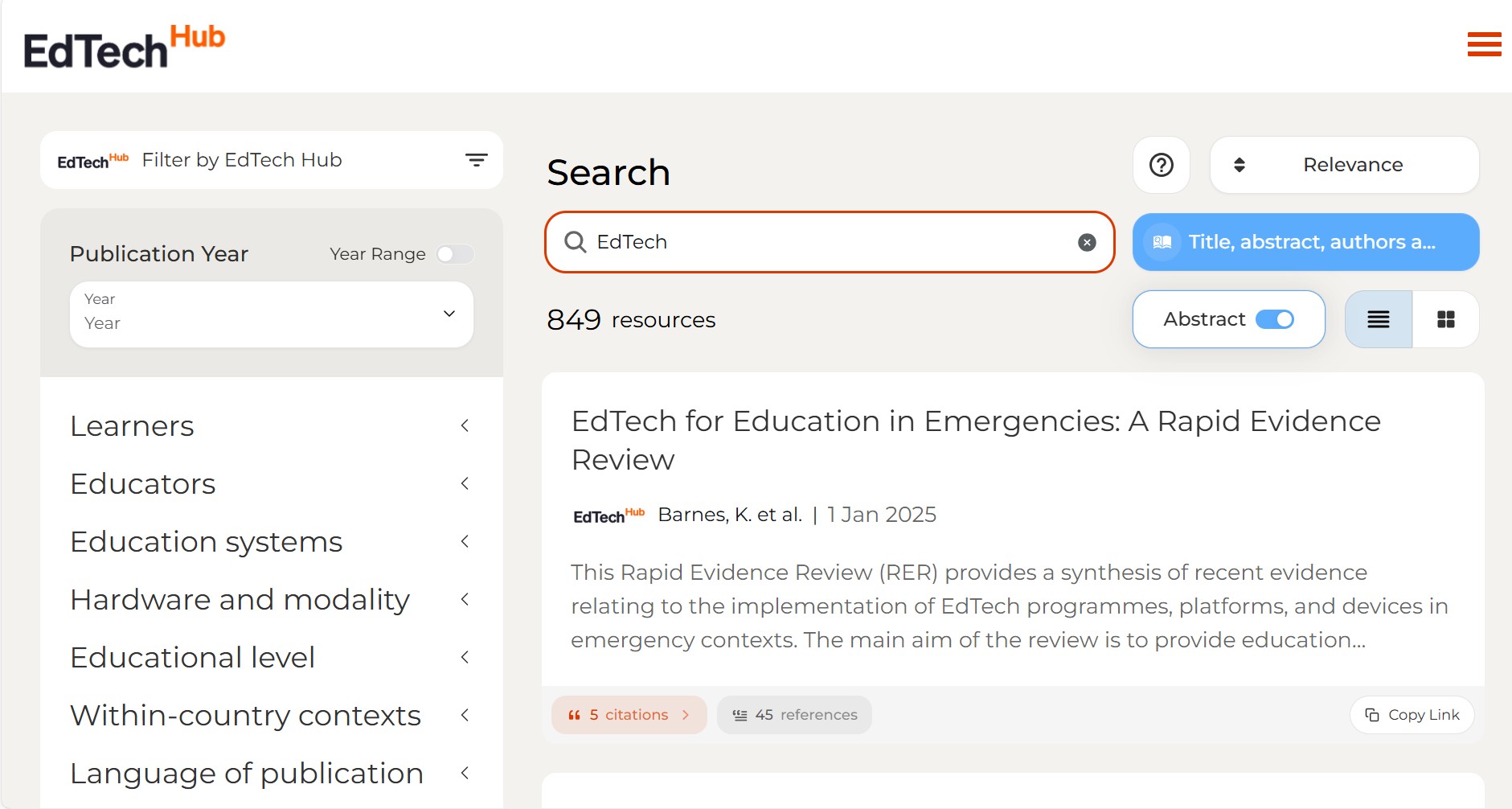
Access context-specific evidence on educational technology in low- and middle-income countries. The EdTech Hub Evidence Library provides policy briefs, learning briefs, case studies, and other resources to help educators, policymakers, and practitioners make informed decisions about using EdTech.
Our evidence agenda
Latest evidence
Key research partners