

Overview & Genesis
Developing policy in the real world rarely follows a straight line. It unfolds amid ambiguity, competing agendas, and external disruptions like leadership changes or shifting public moods. This toolkit was born from a partnership between the Center for Education Standards and Policy (Pusat Studi Kebijakan Pendidikan, PSKP) of the Ministry of Primary and Secondary Education in Indonesia and EdTech Hub.
Originally tailored for the Indonesian context and aligned with the Policy Quality Index (Index Kualitas Kebijakan, IKK), it has been adapted into a Global Edition to provide a high-level strategic framework for country leads navigating complex policy frontiers worldwide.
The Reality of the “Messy Middle:” Navigating the Policy Frontier
In the real world, developing a policy doesn’t happen in a straight line. It unfolds amid ambiguity, competing agendas, and external disruptions like a change in leadership or shifting public moods.
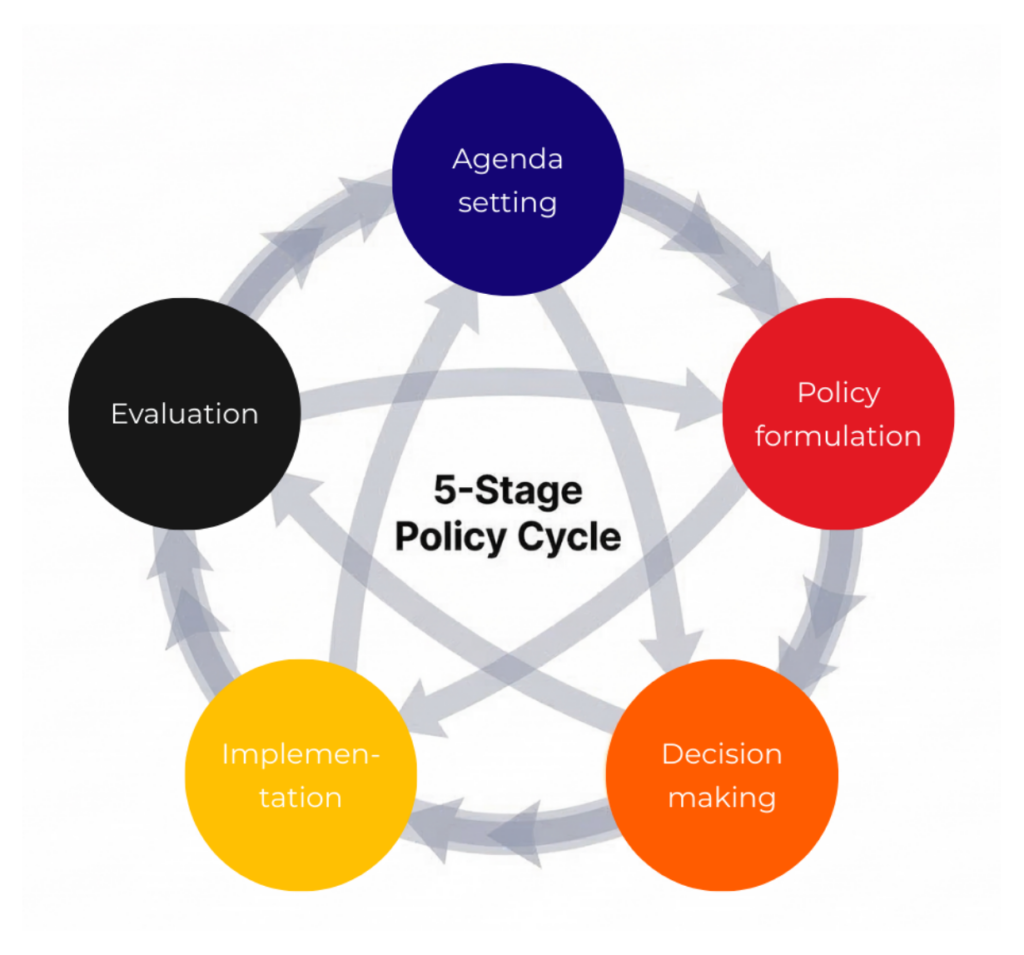
The diagram represents a 5-stage cycle, connected by a web of overlapping arrows, illustrating that policymaking is a constant back-and-forth process .
- Agenda setting
- Policy formulation
- Decision making
- Implementation
- Evaluation
This capsule toolkit is designed to act as a critical and practical companion for navigating this complexity. It provides a structured space to “pause and reflect” and to “refine and align,” ensuring that the speed of the political cycle does not compromise the quality of the outcome.
The Fundamental Theory: The 3Ps in Chaotic Policymaking System
As the “Messy Middle” unfolds, there are three independent streams – problems, policies, and politics– that flow through political systems during policymaking, converging only sporadically during “policy windows” triggered by crises, shift in public mood, or political changes.
(John Kingdon’ Multiple Streams Framework, 1984).
Problem
Issues don’t emerge logically; they erupt through crises, symbols, and social framing. They compete for limited attention in a crowded agenda.
Policy
A “primeval soup” of ideas. Solutions evolve independently of problems, waiting for the right moment to be attached to a crisis.
Politics
Driven by national mood, elections, and power shifts. It dictates timing, opening, and closing “policy windows” regardless of a solution’s merit.
How the Toolkit Helps
This capsule toolkit acts as a practical companion to help teams strengthen policies early while improving the overall design process.
- Encourages Evidence-based Policy: Pushes institutions to build policies based on adequate data.
- Strengthens Good Governance: Aims to improve public participation and transparency in formulation.
- Promotes Sustainability: Strengthens collaboration with stakeholders and the resilience of policies over time.
Toolkit Highlights
The toolkit focuses on six essential elements designed to strengthen policy design and implementation:
Capsule 1 – Policy Landscape Diagnosis
Defining symptoms vs. problems and setting the mindset for scale.
Capsule 2 – Evidence Calibration
Balancing different evidence types, grading evidence fit, and using proxy signals.
Capsule 3 – Monitoring, Learning, and Adaptation (MELA)
Leveraging knowledge management, building psychological safety, and strengthening feedback.
Capsule 4 – Resilience and Stewardship
Preserving institutional memory and establishing guardrails in implementation.
Capsule 5 – Collaborative Intelligence
Mapping stakeholder power and interest while using safe secondary operating spaces.
Capsule 6 – Technical References & Best Practices
A comprehensive compilation of the research, global best practices, and full technical references used to develop the toolkit.
Who Is This Toolkit For?
- Policy Analysts & Researchers: For those designing credible, evidence-based policies that are not only theoretically sound but also implementable on the ground.
- Implementers & Project Managers: For leaders who need to oversee implementation through clear accountability and protect policies from collapsing during systemic transitions.
- Strategic Leaders: For those navigating the speed of the political cycle and looking for a structured space to “pause and reflect” to ensure quality outcomes.
Integrating the Modular Framework
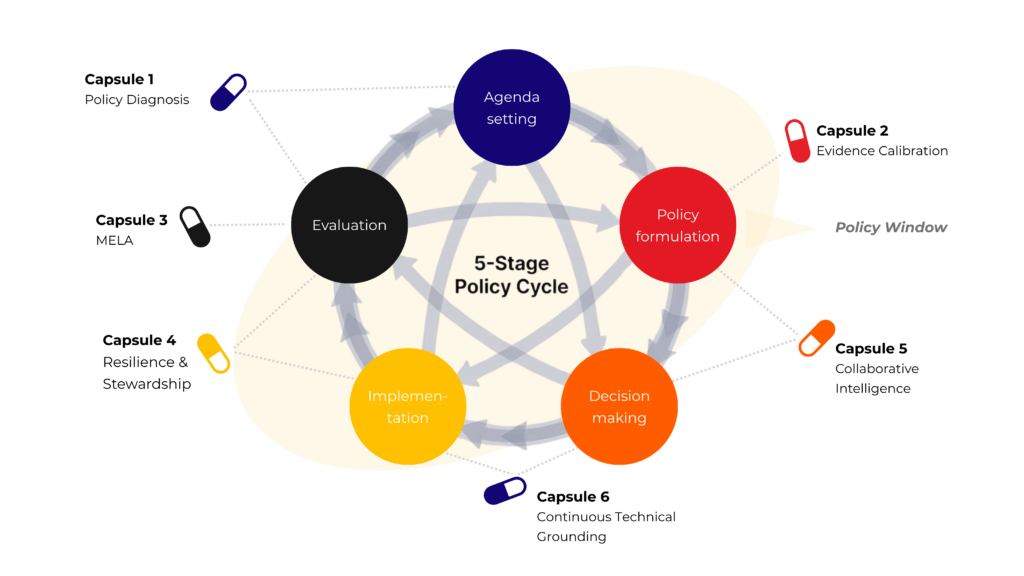
Instead of a linear manual, this toolkit is a modular, pull-on-demand resource designed to support your policy work at any point in the cycle:
- Diagnostic Entry: Use the Quick Diagnostic Tool to bypass the traditional sequence and jump directly to the Capsule that matches your immediate roadblock.
- Cycle Alignment: Integrate specific Capsules as “pause and reflect” zones within the 5-stage cycle (Agenda Setting through Evaluation) to ensure quality is not sacrificed for political speed.
- Continuous Grounding: Keep Capsule 6 active as a persistent technical backbone, providing a constant research anchor regardless of where you are in the iterative process.
- Policy Window Readiness: Use the modular structure to quickly pivot or “refine and align” your strategy when sporadic windows for change suddenly open.
Quick Diagnostic Tool to Get Started
Find the capsule most suited for your current “Real World” context. Start at Question 1. Follow the “No” or “Yet” paths to find your recommended starting point.
Q1: Do you have a clearly defined problem statement and a long-term plan?
NO: Start with Capsule 1 (Policy Landscape Diagnosis) to identify root causes and define the nature of your policy.
YES: Move to Question 2.
Q2: Do you have sufficient research and data to support your case to stakeholders?
NO: Go directly to Capsule 2 (Evidence Calibration: Truth vs. Utility) to determine what further research is needed.
YES: Move to Question 3.
Q3: Are your internal workstreams collaborative, and are your stakeholders aligned on the problem?
NO: Review Capsule 5 (Collaborative Intelligence: Relational Governance) to break down silos and align minds.
YES: Move to Question 4.
Q4: Can your policy survive leadership changes or a lack of immediate stakeholder commitment?
NO: Explore Capsule 4 (Resilience and Stewardship: Building to lAST) to protect the policy from collapsing and identify core partners.
YES: Move to Question 5.
Q5: Do you have a clear plan for how data will be used to monitor progress and make improvements?
NO: Jump to Capsule 3 (MELA: Data as a Strategic Asset) to strategize your monitoring and evaluation efforts.
YES: You are ready for the deep dive! Go to Capsule 6 (References and Further Reading) for full technical references and research.
Download the Strategic Toolkit today
A toolkit for policy and decision-making in EdTech.
This work is part of the portfolio of projects delivered by the ASEAN-UK SAGE programme. The ASEAN-UK SAGE programme is delivered by the British Council and SEAMEO Secretariat, in partnership with EdTech Hub and Australian Council for Educational Research (ACER), and is an ASEAN cooperation programme funded by the UK.