
Why this Sandbox?
We know that learners in low- and middle-income countries (LMICs) were already at a disadvantage before the Covid-19 pandemic. Closing schools in a country like Uganda disproportionately affected learners in marginalised communities.
Radio is one of the longest-serving and most accessible types of educational technology, and has recorded some success in delivering education to learners in LMIC contexts during crises, including the Ebola crisis. We decided it would be particularly useful to focus on radio instruction in this sandbox.
We selected partners Mango Tree Literacy Lab for:
- Their literacy programme in northern Uganda which has been validated by a randomised control trial to have had a significant impact on learning scores.
- Their unique interactive radio instruction model which engages members of the community to facilitate listening centres alongside a radio broadcast.
-
- The ease of access to radio for learners and caregivers in the Lango sub-region.
The question we wanted to answer was: Can we achieve meaningful literacy competencies via interactive radio instruction?
To explore this, the sandbox aimed to test the effectiveness of an interactive radio model to safely deliver education to learners using supplementary materials and in-person facilitators at a central location.
This work was built on solid foundations. EdTech Hub’s Rapid Evidence Review on Radio suggested that radio was cost-effective and an effective modality for teaching languages, and that interactive radio instruction could further enhance teaching.
Rethinking Radio Education with Mango Tree
Mango Tree has been operating in the Lango region of northern Uganda for over a decade, where it has established strong connections with the community. Lango is a post-conflict region still recovering from 20 years of civil war. When the Covid-19 pandemic led to the closures of local schools, the government decided to use radio and television broadcasts as a temporary alternative to in-school teaching.
Mango Tree, with its years of experience and local connections, wanted to take things further. They were keen to understand how lessons by radio could be improved and made more effective; and to find approaches that could potentially be scaled up across the country, and further beyond.
EdTech Hub worked with Mango Tree in September 2020, on a sandbox project to try out new techniques using radio.
Teaching Outside of School
Local radio station Q-FM agreed to provide a 1-hour timeslot in its Saturday broadcasting schedule. The station broadcast pre-recorded lessons for primary-age learners, mainly focused on literacy.
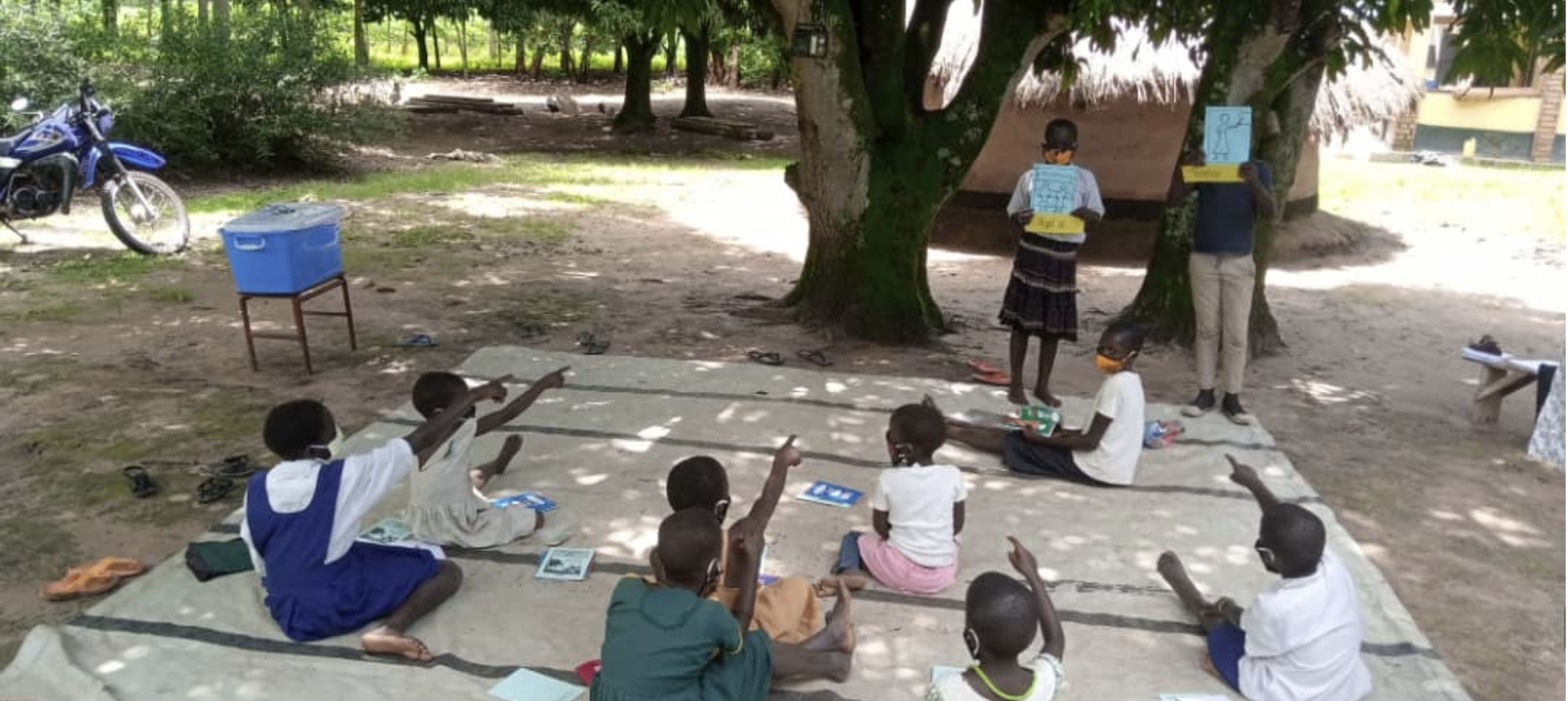
Simultaneously, Mango Tree set out to create ‘listening centres’ where children who didn’t have access to a radio at home could gather in small numbers, outdoors, wearing masks, to listen to broadcasts.
Although schools were forced to close, the arrangements made for the listening centres were designed to make them as Covid-safe as possible and allow them to continue operating despite the pandemic. But listening centres did not rely solely on radio broadcasts. Each lesson was accompanied and facilitated by a member of the local community. We called them co-teachers.
Many of the co-teachers were older children. Some were parents, and some were professional teachers who were temporarily not working due to school closures.
The co-teachers were there to provide a feedback loop that lessons by radio cannot provide. They answered children’s questions, helped clarify anything the children had misheard due to radio reception problems, and helped keep the ‘class’ engaged. Their job was to make the lessons as interactive as possible, and Mango Tree provided them with a guidebook and support from listening centre coordinators to make sure they felt prepared to do this.
Even though the majority of co-teachers were not trained teachers at all, the model proved effective at fostering learning. Children were tested early in the pilot (Week 2) and again after the radio broadcasts (Week 12). These tests showed clear positive learning outcomes. Average percentage scores in name writing, letter names, print awareness, and listening comprehension all increased by significant margins.
- Name writing (+16.1)
- Letter names (+27.6)
- Print awareness (+12.7)
- Listening comprehension (+9.2)
Alongside radio broadcasts and co-teachers, the sandbox arranged for additional learning materials for children, including worksheets, quizzes, and short texts. Again, co-teachers were essential for helping with distribution and instruction on how to use these materials.
In the final week, the pre-recorded radio show was replaced with a live phone-in for children to ask questions on air. Co-teachers were again on hand to facilitate this.

Children in Uganda learning via radio — from our sandbox with Mango Tree Literacy Lab.
An Idea that’s Easy to Copy
Because of necessary Covid-19 restrictions, it was impossible to accommodate more than about 15 children in any single listening centre. But very quickly, parents and caregivers realised they could replicate much of the learning by setting up their own, unofficial listening centres.
We adapted the sandbox quickly to encourage these unofficial centres. We couldn’t provide all of them with co-teachers and supplementary materials, but we were able to supply some of them with additional learning materials to accompany the broadcasts.
We reached over 1000 children in 100 official listening centres — and many more in unofficial ones.
A Community Led Effort
This sandbox could not have been successful without engagement with, and input from, the local community.
Members of the community were an essential component as co-teachers. The close community links meant that parents and caregivers were well informed and involved; some parents told us they were delighted that their children could continue learning outside school.
Co-teachers were a crucial component of the model and, in fact, showed increases in basic literacy learning themselves. We observed that co-teachers formed good relationships with their learners and one another (they were encouraged to communicate with one another, sharing tips and best practices).
It would be easy to sum up the sandbox as an ‘EdTech’ project about radio, but radio was only one ingredient. What was key to the success of this sandbox was the addition of co-teachers, supplementary learning materials, and strong community buy-in. Without these elements, using radio for teaching and learning would have been far less successful.
What We’ve Learnt
- Learning from radio is possible, but involves more than listening to broadcasts and following instruction. The human element is essential and should be coupled with supplementary materials to help facilitate the learning process.
- Good teaching can come from anyone, as long as the instruction is sound and facilitators (in this case, community co-teachers and caregivers) are adequately supported.