
Why this Sandbox?
An EdTech Hub Helpdesk response on distance learning for primary-level deaf children highlighted practical recommendations for educators supporting learners with limited or no access to the internet, hardware, or software. These included providing access to devices, offering modular content, and testing different digital solutions.
At the same time in Pakistan, Deaf Reach was developing short videos in Pakistan Sign Language (PSL) to support deaf learners. A small evaluation, conducted after providing laptops preloaded with these videos to 44 children for three months, showed significant learning gains.
Building on both the Helpdesk recommendations and Deaf Reach’s early success, this sandbox aimed to test a range of EdTech interventions. The goal was to identify which approaches are most suitable for delivering distance learning to deaf children in low-resource contexts.
While they can’t get to school, we want school to get to them.”
– Representative from Deaf Reach
Understanding the Context
There are over a million deaf children in Pakistan, but only a tiny fraction (5%, data from 2019) of them go to school. Deaf Reach, a non-profit education charity, provides schooling for 1,200 deaf children across six schools, all of which had to suddenly and quickly close with the onset of the Covid-19 pandemic. Most of that schooling is about, or conducted in, Pakistan Sign Language (PSL).
Organisers faced an immediate challenge: how could they continue to run PSL lessons remotely?
This sandbox was set up to find practical answers, backed by reliable evidence.
Lessons on Laptops
Before the pandemic, Deaf Reach had already invested in video PSL lessons for young children. Most of them are told using short animated stories. So the sandbox started in a good place, with an existing archive of high-quality video material.
We couldn’t rely on children having good internet connectivity or suitable devices at home. So we needed a way to get the videos to the children without relying on the internet.
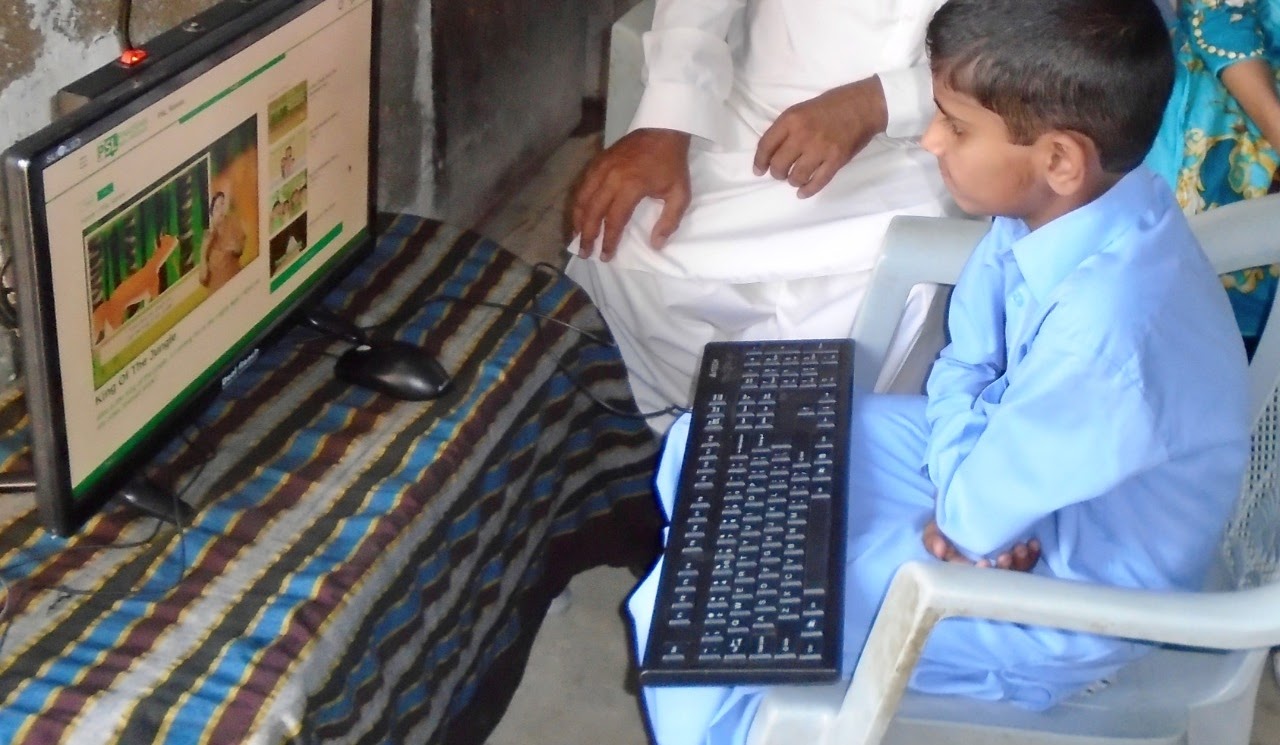
The simplest answer was to load the video archive onto laptops and send those directly to the children at home.
As with all our sandboxes, this one was conducted across a series of short, time-bound sprints. In the first sprint, Deaf Reach sourced 225 laptops and loaded each one with 56 PSL videos. We then distributed them to a cohort of Grade 3, 4 and 5 primary-age children, along with a timetable, worksheets, and lesson plans.
Concerns about the reliability and suitability of laptops proved unfounded. Ninety-five per cent of the laptops were returned in the same condition as when they were distributed, after one month.
Crucially, Deaf Reach gathered important data about the success of the scheme by testing children in PSL before they were given a laptop, and after they’d had one for a few weeks. Average scores before the sprint were 19/45; average scores afterwards were 32/45. A 68% increase, and a clear success.
They also conducted a survey with parents, which uncovered something even more interesting. Most parents (87%) said they helped their child learn PSL, but less than half (47%) felt capable of helping. Most parents of deaf children aren’t deaf themselves, and felt their lack of PSL understanding was a barrier. They wanted to help, but felt ill-equipped to do so.
We’d uncovered something we started to call “the capability-enthusiasm gap”.
Bridging the Gap
In the second sprint, we looked at ways to bridge that gap by re-connecting children with teachers over the phone, using video calls over WhatsApp.
We provided 200 further children with laptops, and video content. Now that we knew video content ‘worked’, Deaf Reach teachers recorded and shared further videos to cover four key subjects: Urdu, Science, Mathematics, and English.
This time, half the participating children were given a smartphone, and we ran a series of onboarding sessions to help them learn how to use it. They were asked to make WhatsApp video calls to teachers, twice a week.
Again, we ran tests with the children at the start and end of the sprint, and conducted surveys with them and with their parents.
The children who had been given smartphones didn’t spend more days per week learning (as we’d expected), but they did perform 35% better in tests than the children without smartphones. Importantly, 93% of users with smartphones found the expanded content ‘easy to navigate’ – compared to 73% of non-smartphone users. This might have played a part in the improvement.
Of course, providing smartphones added a lot of cost, and wouldn’t be easy to scale up. If they get used at all, the best use of smartphones might be to provide them to under-performing children, where the extra direct teacher contact can make the biggest difference.
Scaling Through Partnerships
One promising method of growing this delivery model is by partnering with other NGOs and grassroots organisations, who work with deaf children in other countries. In our third sprint, we worked with Atfaluna, an NGO based in Palestine.
Deaf Reach and Atfaluna worked together to adapt Deaf Reach’s videos into Arabic Sign Language. Six Deaf Reach videos were adapted overall, and this partnership was a first for both organisations. To test whether they worked in a quick experiment, Atfaluna split their children into two groups. One group was taught content by a teacher, who read stories, explained them to a class, and used the blackboard. Another group was presented with the videos, followed by a discussion between teachers and the student. Children who watched the videos showed a 20% improvement relative to the other group.
Deaf Reach provided quite a lot of support to help the partnership work. For example, there was iterative collaboration with Deaf Reach editors as the videos were bring developed. There were also needs to navigate different ways of working: different email processes, different file format preferences, and different working days.
Deaf Reach has now written a service design blueprint for playing this role of “learning consultant” to other organisations. Once it is streamlined, it could be a powerful way to spread both good practice outside of Pakistan. In this case, Deaf Reach provided the funding but in other cases the funding might come from Deaf Reach, the partner, or both organisations.
EdTech Hub’s systematic literature review on EdTech to support learners with disabilities also highlights the importance of integration with schools. Where possible, public schools should cater for deaf learners, rather than those children being streamed into a special school. The role of proven video content in this integration is an area for future inquiry.

Photos of students using smartphones to connect with teachers from our sandbox with Deaf Reach in Pakistan.
What We’ve Learnt
- Pre-loaded offline content on laptops is an effective way of helping children learn remotely.
- Running assessments at the beginning and end of each sprint was a vital part of the sandbox and gave us valuable insight into learning outcomes.
- This is a useful model to follow in other countries and contexts.
- Parents need help and encouragement too.