
The Methodology: Defining the “Sandbox”
To enable both rigour and flexibility, we adopted a Sandbox framework.
- What is it? Originating in software development, a “sandbox” is a controlled, isolated environment where untested code can be run safely without disrupting the entire system.
- How does it translate to action? An EdTech Hub Sandbox provides a “safe space” for partners to test how a new intervention—whether it is a digital tool, a new teaching pedagogy, or a policy change—interacts with the real world. We treat a “mini version” of the education system as a lab, allowing for systematic experimentation before an intervention reaches the stage of (national scaling or legal formalisation.

Co-Design: Building Ownership and Capacity for Sustainable Innovation
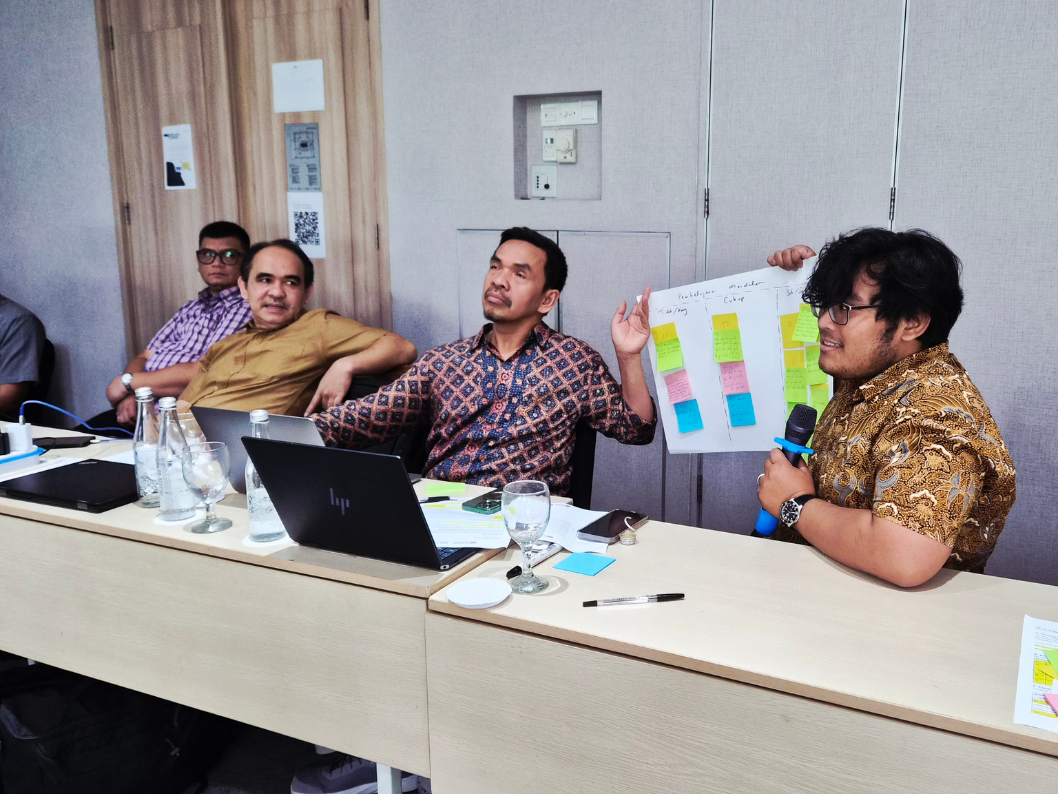
We assembled dedicated teams for each partner, but our role was not to deliver a finished product. Instead, we utilised a co-design approach—from the ideation, to the ‘sprint planning’ and sprint execution—where each phase incorporated design ideas and implementation support from partners to move forward with the development of the product. This moves the process from theoretical training to evidence-based action, ensuring the intervention is not just an event, but a sustainable practice.
This methodology serves four main purposes:
Contextual Alignment
The intervention was built to fit the actual daily habits and practical context of the intended beneficiaries—such as teachers and government officials—not just an assumption of what these stakeholders needed.
Capacity Building and Institutional Knowledge
Partners became co-creators of the solutions/products they were building. This engagement deepened their understanding of the process and strengthened their capacity to replicate similar approaches in future work, ensuring the “how-to” remained within the institution.
Evidence Generation to De-risk Innovation
By testing interventions in a “mini-system” first, we generate the data necessary to identify failures early. This de-risks the eventual rollout, ensuring that when an intervention is scaled, it is both audit-ready and proven to work.
Narrowing the Distance
We bridge the gap between high-level theory and implementation. By involving a mix of stakeholders—from frontline staff to high-level officials—we ensure that the distance between theory and practice is closed.
Core Principles of the Regional Sandbox
- Problem-Centred: Every experiment starts with a clear, localised problem, not a pre-sold technology or a top-down mandate.
- System as the Unit: We don’t just test a tool in isolation; we test how that tool interacts with the whole system, including budgeting, infrastructure, and administrative compliance.
- Continuous Evidence: We don’t wait for a final “evaluation.” We generate evidence constantly to allow for pivots, ensuring the intervention evolves alongside the needs of the users.
Inclusive Design & Equity Principles
The Sandbox methodology ensures that interventions are not just technically functional, but operationally equitable. We prioritise “Safe Failure” in carefully planned environments to prevent “At-Scale Failure” in the real world.
Equity by Design: Multi-Stakeholder Governance
To ensure the final products reflect diverse realities, we moved beyond top-down mandates. Across all three sandboxes, we ensure perspectives from multiple stakeholders are integrated into the design process:
- High-Level Leaders: Vision Alignment and Strategic Shielding
They ensure the intervention aligns with national goals and regional standards. Their role is to provide the top-down legitimacy and political backing needed for the project to move from experiment to institutionalised practice.
- Implementors: Operational Feasibility
These are the technical units, administrative staff, and local partners who manage the functional requirements. They identify gaps in infrastructure, budget, and staffing to ensure the intervention is audit-ready and operationally viable at scale.
- End-Users & Beneficiaries: Practicality and Front-line Adoption
This layer represents the individuals who interact with the intervention daily. By involving those directly impacted and most vulnerable end-users, we ensure the design is intuitive, solves actual on-the-ground challenges, and avoids unnecessary cognitive load. Their focus is on day-to-day usability and immediate value. Through iterative feedback loops, sandbox designs create opportunities for direct improvements in interventions.
This was operationalised through multi-modal data collection (surveys, KIIs, and workshops) and cross-participant learning opportunities to capture voices and perspectives in both online and face-to-face environments, ensuring the design accounted for varying capability and time constraints throughout the different cycles of the sandbox sprints.
This work is part of the portfolio of projects delivered by the ASEAN-UK SAGE programme. The ASEAN-UK SAGE programme is delivered by the British Council and SEAMEO Secretariat, in partnership with EdTech Hub and Australian Council for Educational Research (ACER), and is an ASEAN cooperation programme funded by the UK.