
Introduction: Diverse Needs, One Common Thread
In 2025, EdTech Hub received a series of distinct Helpdesk requests from Ministries of Education in the Philippines and Indonesia, as well as from regional partners like SEAMEO VOCTECH, a SEAMEO Centre focused on Vocational Technical Education and Training, based in Brunei. While the specific challenges across regions varied significantly in scope and context, a pattern emerged: These were not static problems that could be solved with a rigid, “one-size-fits-all” solution. They required flexibility, rapid iteration, and deep contextual understanding.
EdTech Hub, through the ASEAN-UK SAGE Programme, launched a series of sandboxes to solve these challenges.
We worked directly with the following partners and institutions:
Ministry of Primary and Secondary Education (MoPSE), Indonesia
Institutional Stewardship: Working with ministry units and technical teams to bridge the gap between administrative compliance and evidence-based policymaking.

Department of Education (DepEd), the Philippines
Inclusive Data Systems: Supporting school heads and teachers in remote and underserved schools to ensure digital readiness tools are practical and valuable for educators in resource-constrained environments.
SEAMEO VOCTECH, Regional SEAMEO Centre focused on TVET
Vocational Support: Equipping TVET (Technical and Vocational Education and Training) educators and learners with AI-supported tools to improve engagement in self-paced learning.

To enable both rigour and flexibility, we adopted a Sandbox framework. Read more about our methodology and inclusive design principles here.
While the technical and administrative landscapes varied across the Philippines, Indonesia, and Brunei, every experiment was governed by a shared, evidence-led methodology. This process moved each project from a theoretical policy goal to a validated, field-tested solution.
The Four-Pillar Validation Lens
To ensure holistic success, every intervention was interrogated through a standardised set of four “Hurdles”:
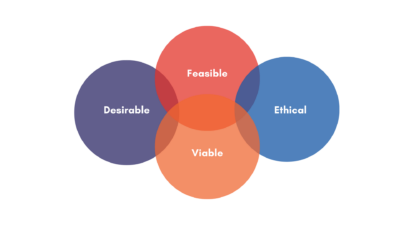
Desirability
Does it solve a felt need? We test if the tool reduces friction for the actual human user.
Feasibility
Can it work here? We test the intervention against the specific technical, legal, and infrastructure limits of the local environment.
Viability
Is it sustainable? We test if the intervention aligns with long-term national budgets and policy roadmaps.
Ethical Design
Is it responsible? We assess data privacy, transparency, and the potential to widen the gap between different groups of users. This involves assessing whether an intervention might unintentionally favour those with higher technical literacy or better infrastructure.
Unlocking Agility through The Sprint Cycles
To move beyond theoretical policy, each sandbox followed an agile, three-stage sprint architecture. This process was built on a “doing to learn” philosophy.
Sprint 0
Moving from “What do we want to build?” to “What are the risks that will stop this from working?”
Sprint 1
Moving from “Does it look good?” to “Can it survive the friction of the real world?”
Sprint 2
Moving from “Can they use it?” to “Will it improve the system long-term?”
Regional Application Overview
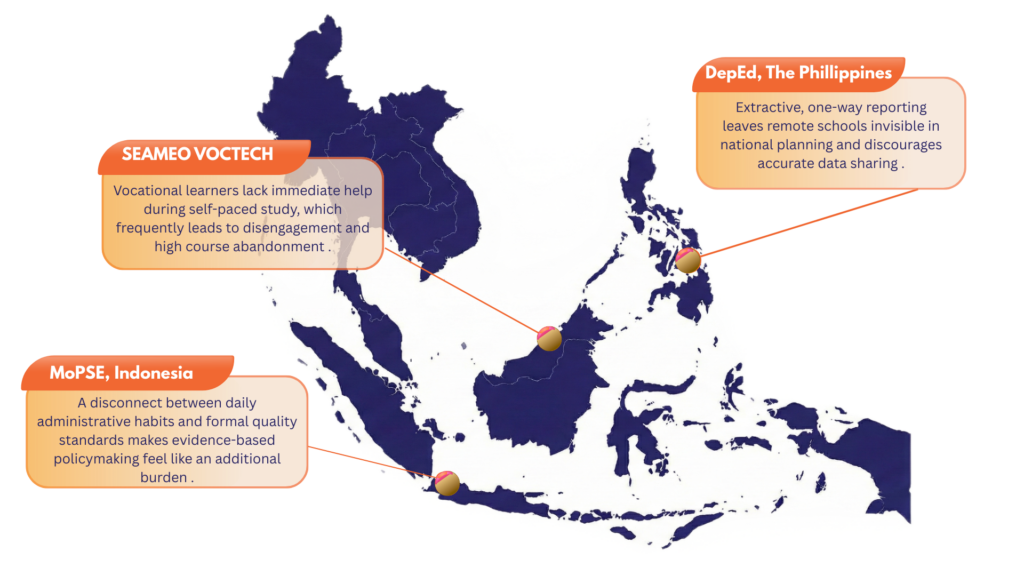
This structured methodology was applied to three unique challenges across Southeast Asia:
Department of Education (DepEd), the Philippines
The Challenge
The need for a reliable, human-centred way for schools to self-assess their EdTech infrastructure and readiness.
The Intervention
Testing the DMA (Digital Maturity Assessment) tool’s desirability and feasibility, specifically within “Last-Mile” (remote/vulnerable) schools, to ensure data accuracy and user safety.
The Output
Data Integrity through Local Value. The sandbox found that when a tool provides immediate value for a school’s own planning, users provide more honest and accurate data. The output is a “value-for-data” exchange that improves national data quality.
Learn moreMinistry of Primary and Secondary Education (MoPSE), Indonesia
The Challenge
A gap between the linear requirements of the National Policy Quality Index (IKK) and the non-linear, unpredictable reality of daily policymaking.
The Intervention
A modular “Policy Toolkit” designed for layered usability, allowing units to meet immediate compliance needs while building long-term evidence-based habits.
The Output
Standardisation of existing habits. The sandbox proved that evidence-based policymaking is already happening; the toolkit’s primary output is a mechanism to document these existing practices into audit-ready evidence that meets the “Excellent” (80+) IKK score.
Learn moreSEAMEO VOCTECH
The Challenge
High attrition rates in self-paced, asynchronous vocational courses across Southeast Asia.
The Intervention
Testing the integration of an AI chatbot to provide multilingual support and immediate feedback for diverse learners.
The Output
A Psychological Safety Net. The sandbox revealed that AI’s greatest impact is as a “friction-reducer.” Learners utilised the AI to ask questions they felt “judged” for asking a human, providing a safe space for learning when instructors were unavailable.
Learn moreThis work is part of the portfolio of projects delivered by the ASEAN-UK SAGE programme. The ASEAN-UK SAGE programme is delivered by the British Council and SEAMEO Secretariat, in partnership with EdTech Hub and Australian Council for Educational Research (ACER), and is an ASEAN cooperation programme funded by the UK.